
All-Season vs. All-Weather vs. Winter Tires: What the Labels Really Mean

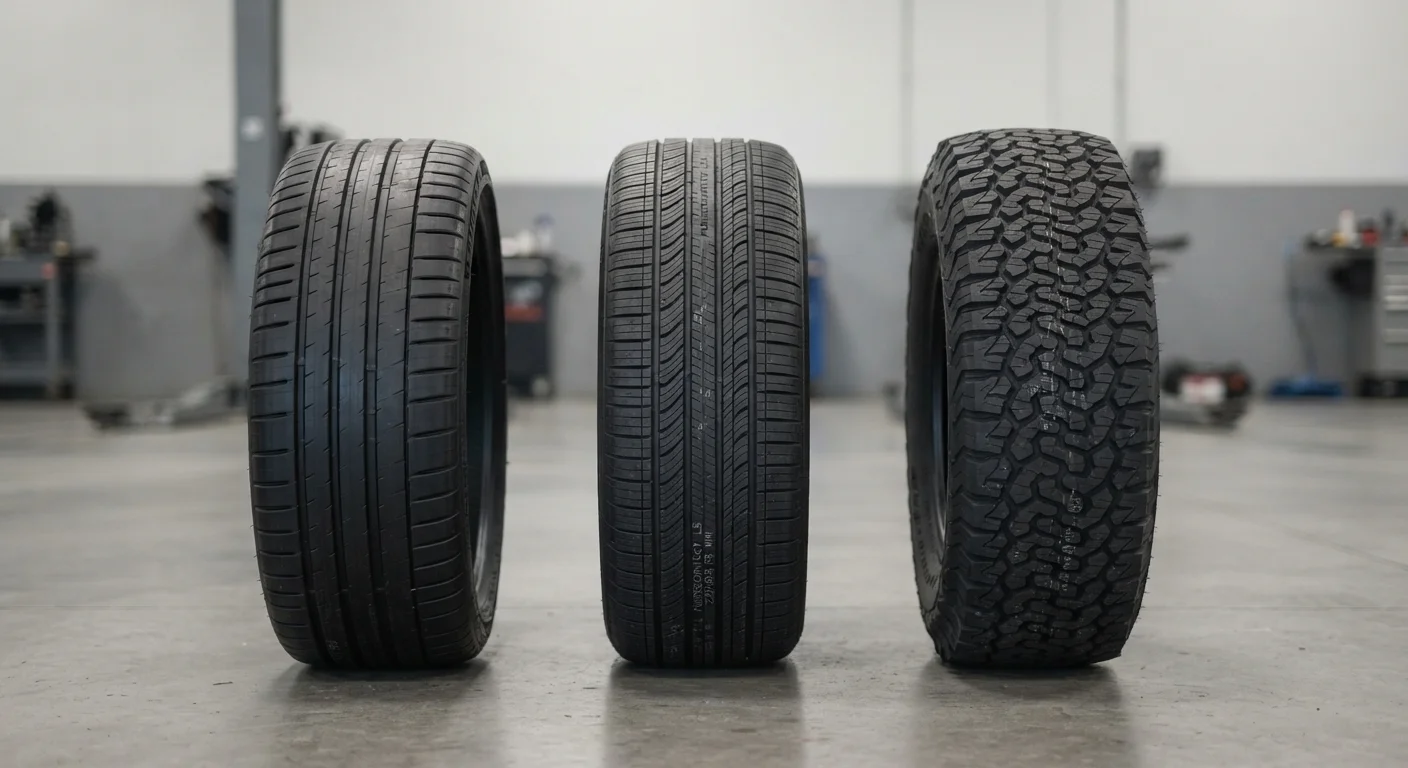
Photo: findbestways.com editorial
What the labels actually certify
Tire marketing language can obscure what a label actually means in technical terms. Two industry symbols govern winter performance claims in the United States and Canada, and they are not interchangeable.
The M+S (Mud and Snow) designation appears on most all-season tires. It indicates that the tire's tread geometry meets a basic geometric ratio for mud and snow shedding, but no performance test is required to earn it. A tire can carry M+S after a simple tread measurement calculation.
The Three-Peak Mountain Snowflake (3PMSF) symbol means the tire passed a standardized acceleration traction test on packed snow, achieving at least 110 percent of the traction index of a defined reference tire. That test is conducted by an accredited laboratory. Only tires that pass it can display the mountain-and-snowflake graphic.
All-weather and winter tires both carry the 3PMSF. Most all-season tires do not. That single distinction drives most of the practical difference between the three categories. Reading your tire sidewall will show you exactly where to find these symbols on a mounted tire.
All-season tires
All-season tires are designed for dry pavement, wet roads, and light snow. The rubber compound is formulated to stay reasonably flexible across a wide temperature range, roughly 20 to 80 degrees Fahrenheit, without fully hardening or becoming too soft.
The tread pattern typically uses moderate siping (small cuts in the tread blocks) and circumferential grooves to channel water. These features help in light slush and fresh snow, but packed snow and ice push the design beyond its intended use.
Below about 45 degrees Fahrenheit, the compound in most all-season tires begins to stiffen, which reduces the contact patch compliance that produces grip. This is a material science constraint, not a flaw in any particular product. In regions where temperatures stay above that threshold most of the year, all-season tires are a practical, cost-effective choice.
All-weather tires
All-weather tires occupy a middle position. They carry the 3PMSF certification, meaning they have been tested for winter traction, and they use a compound that remains more pliable at lower temperatures than a standard all-season tire.
The tradeoff is that the softer compound wears faster on hot summer pavement compared with a dedicated all-season tire. Drivers in regions with hot summers may see shorter tread life if they stay on all-weather tires year-round.
For drivers in climates that see cold winters with moderate snow but not prolonged subzero temperatures, all-weather tires eliminate the cost and logistics of maintaining two separate sets. They are a reasonable fit for much of the northern United States and Canada's transitional zones.
Check the sidewall before assuming
Winter tires
Winter tires (sometimes called snow tires) use a rubber compound engineered to remain soft below 45 degrees Fahrenheit. That softness lets the tire conform to road surface irregularities, including ice crystals, maintaining friction where a harder compound would skate.
The tread designs on winter tires typically include aggressive siping, larger void ratios (more open space in the tread to bite into snow), and in some cases metal or ceramic studs for pure ice. Studded tires are subject to state-level regulations that vary widely, so drivers should confirm what is permitted in their area before purchasing.
Winter tires also wear faster on warm, dry pavement because the soft compound abrades more quickly. Most manufacturers and automotive engineers recommend installing them as a complete set of four to maintain balanced handling. Running two winter tires on a front-wheel-drive car and two all-season tires on the rear can create unpredictable oversteer on slippery surfaces.
Storage is a real cost to factor in. A second set of wheels mounted with winter tires simplifies the seasonal swap and can reduce the labor cost at a tire shop, since mounted wheels require only a torque wrench rather than a full mount-and-balance procedure.
Comparing the three across key factors
| All-season | All-weather | Winter | |
|---|---|---|---|
| 3PMSF certification | No | Yes | Yes |
| Best temperature range | Above 45 F year-round | Variable, cold to moderate | Below 45 F |
| Ice and packed snow grip | Limited | Moderate | Strong |
| Warm-weather tread life | Longest | Moderate | Shortest |
| Requires seasonal swap | No | No | Yes |
| Second set needed | No | No | Recommended |
| M+S marking | Typically yes | Yes | Yes |
Drivers in areas that see sustained winter conditions typically get the most consistent results from a seasonal switch to dedicated winter tires, despite the added expense. Drivers in mild climates or transitional regions have more flexibility.
The content provided on our blog site traverses numerous categories, offering readers valuable and practical information. Readers can use the editorial team’s research and data to gain more insights into their topics of interest. However, they are requested not to treat the articles as conclusive. The website team cannot be held responsible for differences in data or inaccuracies found across other platforms. Please also note that the site might also miss out on various schemes and offers available that the readers may find more beneficial than the ones we cover.