
How to Read Your Tire Sidewall: A Plain-Language Breakdown

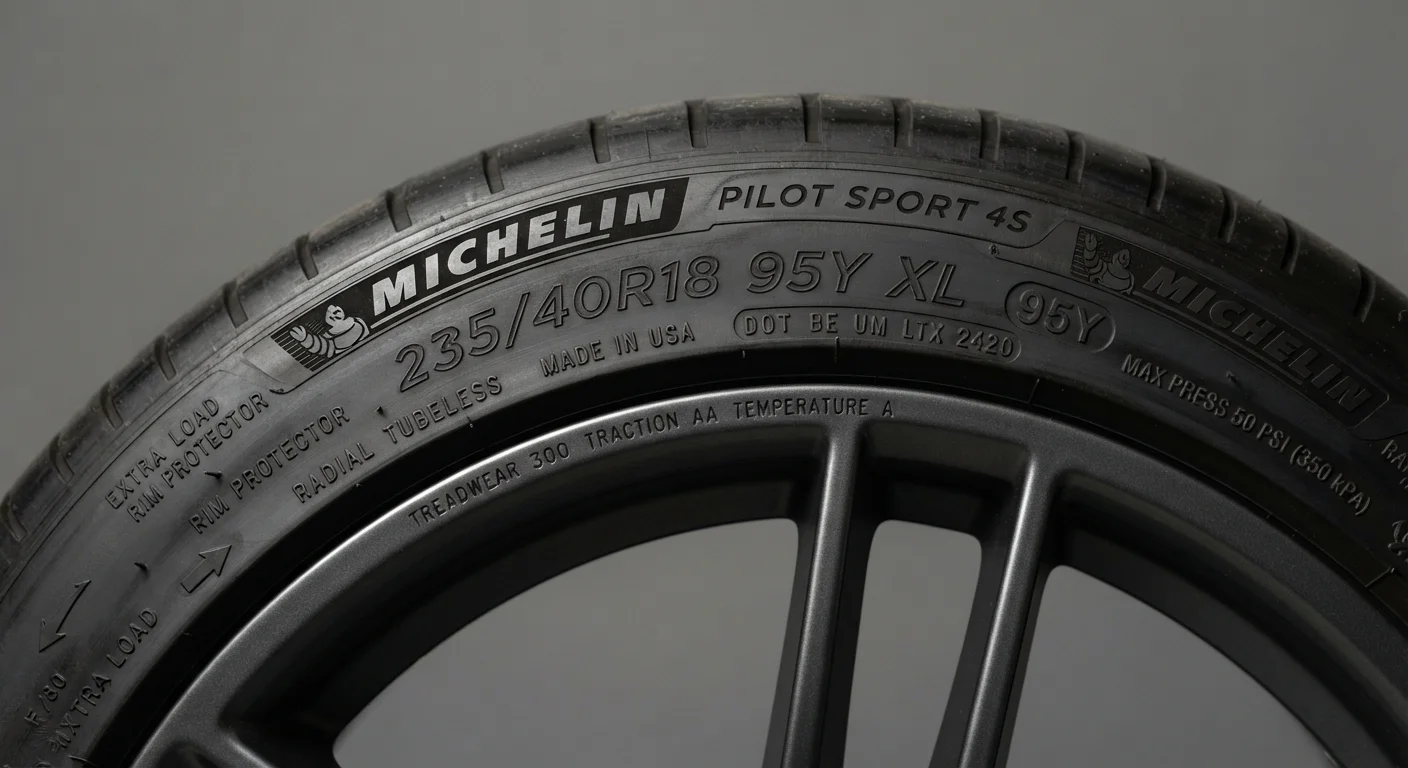
Photo: findbestways.com editorial
What the main size code means
The most prominent string on any tire sidewall looks something like P215/65R17. Each segment of that code describes a physical dimension or construction detail.
The leading letter (or letters) indicates the tire's service type. P stands for passenger vehicle. LT marks a light truck tire, which has a higher load capacity and different inflation requirements. Some tires carry no letter at all; those are built to European metric standards and handle load calculations slightly differently.
The three-digit number that follows is the section width in millimeters, measured from sidewall to sidewall when the tire is mounted and properly inflated. In the example above, 215 mm is roughly 8.5 inches wide.
The two-digit number after the slash is the aspect ratio, which expresses the sidewall height as a percentage of the section width. A ratio of 65 means the sidewall height is 65% of 215 mm, or about 140 mm. Lower aspect ratios (45, 40) mean shorter sidewalls, which tend to improve handling response but reduce ride cushioning.
The letter R stands for radial construction, the standard in passenger and light truck tires today. Radial tires have cord plies that run perpendicular to the direction of travel, then a belt of steel or fabric laid at an angle on top.
The final number is the wheel diameter in inches. A 17 means the tire fits a 17-inch rim.
| Tire size example | P215/65R17 96H |
| Section width unit | Millimeters |
| Wheel diameter unit | Inches |
| Date code digits | Last 4 digits of DOT code (week + year) |
| Minimum replacement age guidance | 6 to 10 years from manufacture date (Tire manufacturer and NHTSA general guidance) |
| Load index 96 equals | 1,565 lbs per tire maximum (Tire and Rim Association load index table) |
Load index and speed rating
Immediately after the size code you will find two more values: a load index number and a speed rating letter. An example: 96H.
The load index is a compressed number that maps to a maximum weight the tire can support at full inflation. An index of 96 corresponds to 1,565 pounds per tire. Your vehicle's door jamb sticker lists the minimum load index the manufacturer requires; never install tires with a lower index than that figure.
The speed rating letter indicates the maximum sustained speed the tire is designed to handle. Common ratings include S (112 mph), T (118 mph), H (130 mph), V (149 mph), and W (168 mph). Matching or exceeding the original equipment speed rating is the correct approach; a lower-rated tire can overheat at highway speeds even if the size is correct.
Aspect ratio
The sidewall height expressed as a percentage of the tire's section width. A lower number means a shorter sidewall.
Load index
A number that maps to the maximum weight one tire can support at full inflation. Always match or exceed the vehicle manufacturer's minimum.
Speed rating
A letter code indicating the maximum sustained speed a tire is engineered to handle safely. Never install tires rated below the original equipment specification.
UTQG
Uniform Tire Quality Grading. A U.S. government system that grades tires on treadwear endurance, wet traction, and heat resistance.
3PMSF symbol
The three-peak mountain snowflake symbol. It indicates a tire passed a standardized snow traction test and is a more reliable winter performance indicator than the M+S designation.
Radial construction
A tire design in which the cord plies run perpendicular to the direction of travel, topped by stabilizing belts. It is the standard construction for passenger and light truck tires.
DOT code and manufacture date
Every tire sold in the United States carries a DOT code, a string of letters and numbers that begins with 'DOT' and ends with a four-digit date code. That date code is the most practically useful part for everyday owners.
The last four digits tell you the week and year the tire was manufactured. 2419 means the 24th week of 2019. Tire manufacturers and safety organizations generally advise replacing tires that are six to ten years old regardless of tread depth, because rubber compounds degrade over time even on tires that look undamaged. Check the date code on any used vehicle purchase and on spare tires, which often sit unused for years.
The characters before the date code identify the manufacturing plant and tire line. That information matters primarily for safety recall lookups, which you can run using the full DOT string at the National Highway Traffic Safety Administration (NHTSA) website.
Other markings worth knowing
Several additional markings appear on the sidewall, each serving a specific purpose.
- UTQG ratings (Uniform Tire Quality Grading): Three numbers and a letter grade covering treadwear, traction, and temperature resistance. Treadwear is a relative index; a tire rated 400 is expected to last roughly twice as long in government testing as one rated 200. Traction grades (AA, A, B, C) reflect wet-braking performance on standardized surfaces. Temperature grades (A, B, C) indicate how well the tire dissipates heat at speed.
- MAX LOAD and MAX PRESSURE: These are the tire manufacturer's absolute limits, not the recommended operating figures. Use the pressure on your door jamb sticker for daily driving, not the max pressure embossed on the sidewall.
- Rotation direction arrows: Directional tires carry an arrow showing which way the tire must rotate when mounted. Installing a directional tire backward reduces its ability to channel water and can increase stopping distance on wet roads.
- M+S or the mountain/snowflake symbol: M+S (mud and snow) is a self-declared marketing designation. The three-peak mountain snowflake (3PMSF) symbol indicates the tire passed a standardized traction test in snow conditions. For winter driving, the 3PMSF symbol is the more meaningful of the two. See how all-season, all-weather, and winter tires differ for a full explanation of what those labels mean in practice.
If a dashboard warning light appears alongside a tire concern, knowing what your warning lights signal can help you decide how urgently to act.
The content provided on our blog site traverses numerous categories, offering readers valuable and practical information. Readers can use the editorial team’s research and data to gain more insights into their topics of interest. However, they are requested not to treat the articles as conclusive. The website team cannot be held responsible for differences in data or inaccuracies found across other platforms. Please also note that the site might also miss out on various schemes and offers available that the readers may find more beneficial than the ones we cover.