
Leasing vs. Financing a Car: What Changes for Your Everyday Budget

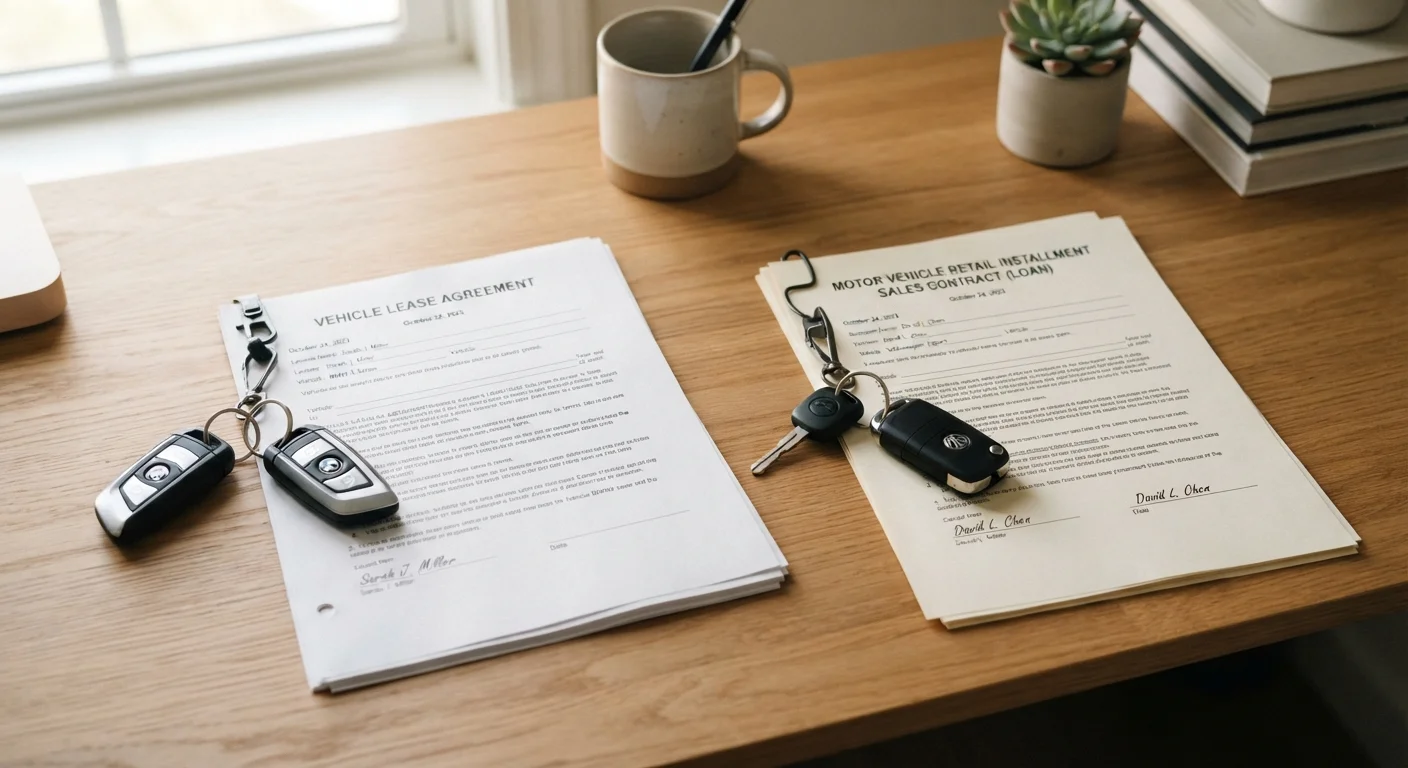
Photo: findbestways.com editorial
Key Takeaways
- Lease payments are typically lower than loan payments because you pay only for depreciation during the lease term.
- Financing builds equity over time; leasing does not leave you with an asset at the end of the term.
- Leases come with mileage limits and wear-and-tear charges that can add up for high-mileage drivers.
- Financing gives you the freedom to modify, sell, or trade the vehicle whenever you choose.
- The total cost of repeatedly leasing the same class of vehicle over a decade is generally higher than buying and keeping.
- Gap coverage is worth considering under either arrangement if you owe more than the car is worth.
How each arrangement is structured
When you lease, you are paying for the vehicle's expected depreciation during the contract period, plus interest (called the money factor) and fees. At the end of the term, typically 24 to 36 months, you return the car or exercise a purchase option at a predetermined price. You never own equity in the vehicle unless you buy it out.
When you finance, a lender pays the full purchase price and you repay the principal plus interest over the loan term, commonly 48 to 72 months. Each payment reduces what you owe. Once the loan is paid off, you own the car outright and can sell it, trade it, or drive it until it stops running.
The structural difference shapes every other comparison: leasing is a usage agreement; financing is a purchase with borrowed money.
Gap coverage applies to both arrangements
Monthly payment and upfront costs
Lease payments are lower than loan payments on the same vehicle because the lease payment covers only a portion of the car's value. A vehicle priced at $35,000 that retains 55 percent of its value after three years has about $15,750 in depreciation to finance, not $35,000. That math produces a smaller monthly figure.
Upfront costs vary. Leases often require a capitalized cost reduction (a down payment that lowers your monthly payment), the first month's payment, a security deposit, and acquisition fees. Financing requires a down payment and sometimes origination fees. Putting more money down on either arrangement reduces monthly payments but does not change the total amount owed on a loan or the total cost of a lease.
| Criterion | Leasing | Financing |
|---|---|---|
| Monthly payment | Lower (covers depreciation only) | Higher (covers full purchase price) |
| Ownership at end of term | None (unless you buy out) | Full ownership |
| Mileage limits | Yes, with overage fees | No limits |
| Modification freedom | Restricted by lessor | Unrestricted |
| Early exit cost | Early termination fee | Pay off remaining balance |
| Long-term total cost | Higher if you lease continuously | Lower once loan is retired |
| Equity built | None | Increases with each payment |
Mileage, condition, and flexibility
Leases include an annual mileage allowance, most commonly 10,000 to 15,000 miles. Exceeding that allowance triggers per-mile charges, usually 15 to 25 cents per mile, billed at lease end. A driver who exceeds the cap by 5,000 miles at 20 cents per mile owes $1,000 at turn-in, which is money spent with nothing to show for it.
Lessors also charge for wear beyond what their contract defines as normal: significant dents, stained upholstery, or tires below a certain tread depth can generate additional fees. Owners face no such charges from a lender, though they absorb repair costs themselves.
Flexibility is another gap. With a financed vehicle, you can sell or trade it at any time. Breaking a lease early typically involves an early termination fee that can equal several months of remaining payments. If your situation changes, a lease is harder to exit without a financial penalty.
For a broader look at how deferred vehicle costs compound over time, see our breakdown of the real costs of skipping routine maintenance.
Total cost over time
Comparing a single lease term to a single loan term favors leasing on monthly cash flow. Comparing a decade of continuous leasing to buying and holding a financed vehicle usually favors financing. Once the loan is paid off, ownership costs drop to insurance, maintenance, and registration. A lessee who rolls from one three-year lease to the next never reaches that lower-cost phase.
The gap widens when you account for what economists call the residual value: the car you own is worth something at the end. A seven-year-old vehicle that has been well maintained can still be sold or traded toward a replacement. A lease produces no such asset.
That said, drivers who genuinely trade vehicles every three years and would otherwise buy new each time may find the cost difference smaller than it appears, because they absorb the steepest depreciation on each financed vehicle anyway. The math depends on negotiated prices, interest rates, and how long you actually keep financed vehicles. Subscriptions and recurring payments of all kinds, including vehicle leases, are worth auditing periodically against what you actually use, much like reviewing recurring digital subscription costs.
The content provided on our blog site traverses numerous categories, offering readers valuable and practical information. Readers can use the editorial team’s research and data to gain more insights into their topics of interest. However, they are requested not to treat the articles as conclusive. The website team cannot be held responsible for differences in data or inaccuracies found across other platforms. Please also note that the site might also miss out on various schemes and offers available that the readers may find more beneficial than the ones we cover.