
Common Car Fluid Myths That Lead to Expensive Mistakes

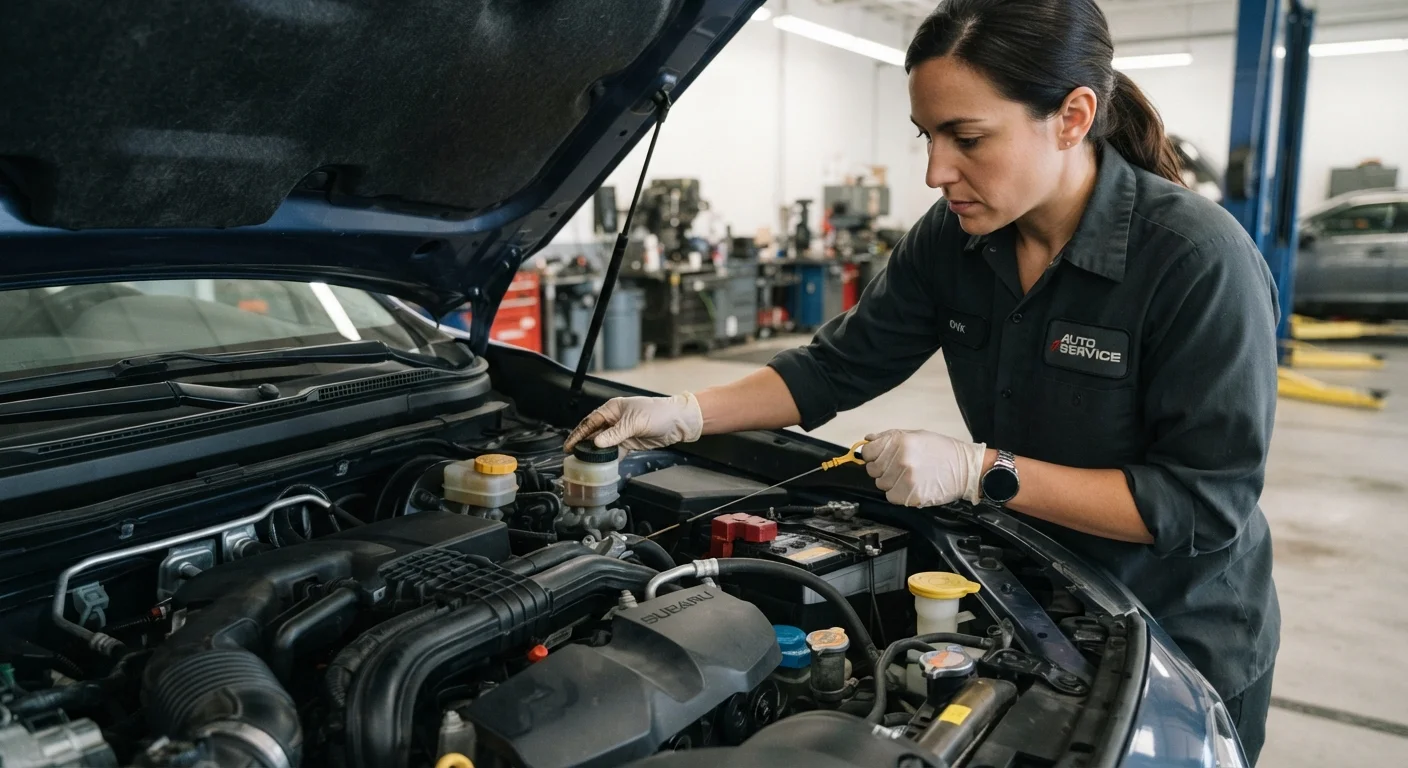
Photo: findbestways.com editorial
Key Takeaways
- The 3,000-mile oil change rule is outdated; most modern vehicles can go significantly longer between changes.
- Darker oil color alone does not mean the oil needs to be replaced.
- Coolant, transmission fluid, and brake fluid each have their own service intervals that most drivers overlook.
- Your owner's manual is the most reliable guide to fluid service schedules, not quick-lube shop recommendations.
- Skipping real fluid service intervals causes long-term mechanical damage that far outweighs short-term savings.
Why fluid myths are so persistent
Car fluid advice travels fast, passed down from parents, repeated at oil change shops, and reinforced by outdated rules of thumb. Some of it was accurate decades ago but no longer applies to modern vehicles. Some was never accurate at all. Acting on bad information leads to two kinds of mistakes: spending money on service you don't need, or skipping service your car actually does need.
The myths below cover the fluids most drivers interact with regularly. Each one gets corrected with the reasoning behind the correction, so you can make decisions based on how your specific vehicle actually works. Your owner's manual remains the most reliable reference for every service interval mentioned here.
For a broader look at what real maintenance involves, see everything involved in keeping a used car running well.
Myth
You need to change your oil every 3,000 miles.
Fact
Most modern vehicles with conventional oil are designed for 5,000- to 7,500-mile intervals, and many using full synthetic oil can go 10,000 to 15,000 miles between changes.
The 3,000-mile rule dates to an era of older engine designs and lower-quality motor oil. Modern engines have tighter tolerances, and synthetic and synthetic-blend oils degrade far more slowly than the conventional oils common in the mid-20th century. The American Automobile Association (AAA) has published guidance noting that many drivers change their oil more frequently than their vehicle requires.
The correct interval for your vehicle is printed in your owner's manual. Many vehicles also have an oil life monitoring system that calculates when a change is actually needed based on driving conditions, not just mileage. Following the manual or the monitor instead of the 3,000-mile rule reduces unnecessary spending without harming the engine.
Myth
If the oil looks dark, it needs to be changed immediately.
Fact
Dark oil color is normal and expected. Oil darkens as it does its job of suspending combustion byproducts. Color alone is not a reliable indicator that oil has lost its protective properties.
Oil turns dark quickly, often within a few hundred miles of a fresh change, because it picks up carbon and other combustion deposits. That darkening is the oil working correctly. What actually determines whether oil needs changing is its remaining additive life and viscosity, neither of which you can assess by sight.
Milky or frothy oil is a legitimate warning sign, since it can indicate coolant mixing with oil, which points to a head gasket problem. Gritty or metallic-smelling oil is also worth investigating. But brown or black color on its own is not cause for an early change.
Myth
Coolant (antifreeze) never needs to be flushed if you just top it off.
Fact
Coolant degrades over time. Its corrosion inhibitors break down, and it becomes acidic, which can damage the radiator, water pump, and heater core.
Topping off coolant keeps the level correct, but it does not restore the inhibitor package. Most manufacturers recommend a full coolant flush on a schedule ranging from every two years to every five years, depending on the coolant type and vehicle. Long-life coolants (often labeled OAT or HOAT) have longer service lives, but they still have limits.
Old, acidic coolant corrodes aluminum components and can cause scale buildup that reduces cooling efficiency. A coolant flush is relatively low-cost maintenance that protects expensive components. Check your owner's manual for the specific type of coolant your vehicle requires, since mixing different types can reduce their effectiveness.
Myth
Transmission fluid is a lifetime fluid and never needs changing.
Fact
Most manufacturer 'lifetime' fluid claims refer to the transmission's design life under ideal conditions. In real-world driving, most transmission fluids benefit from changes on a schedule, particularly in vehicles used for towing or stop-and-go driving.
Some manufacturers have labeled transmission fluid as 'fill for life,' meaning the fluid is designed to last the life of the vehicle under normal use. In practice, transmission fluid breaks down under heat and pressure. Vehicles driven in severe conditions, including frequent towing, mountainous terrain, or heavy city traffic, generate more heat, which accelerates fluid degradation.
Many independent mechanics and transmission specialists recommend changing automatic transmission fluid every 30,000 to 60,000 miles in vehicles driven in those conditions, even when the manufacturer does not specify a change interval. Consult your owner's manual and, if you tow or drive in demanding conditions, discuss the interval with a qualified mechanic.
Myth
Brake fluid doesn't really need to be replaced unless there's a problem.
Fact
Brake fluid is hygroscopic, meaning it absorbs moisture from the air over time. Moisture lowers the fluid's boiling point and can cause corrosion inside the braking system.
As brake fluid absorbs water, its boiling point drops. Under hard braking, fluid that has absorbed significant moisture can vaporize, creating air bubbles in the lines. This is called brake fade, and it reduces stopping power at the worst possible moment. Most manufacturers recommend replacing brake fluid every two years or per a mileage interval specified in the owner's manual.
A simple test strip can measure moisture content in brake fluid, which gives a more precise picture than guessing by age. This is a low-cost check any shop can perform. Because brake system integrity directly affects safety, this is one maintenance item worth staying current on.
Myth
Power steering fluid and windshield washer fluid are interchangeable in a pinch.
Fact
They are completely different fluids with different chemical compositions. Using the wrong fluid in either system can cause damage or a safety risk.
Power steering fluid is a hydraulic fluid formulated to lubricate and pressurize a specific type of system. Windshield washer fluid is a water-based cleaning solution. Using washer fluid in a power steering reservoir can damage seals and internal components. Using power steering fluid in the washer system is less mechanically dangerous but will coat your windshield with an oily film that impairs visibility.
Even within power steering fluid, different vehicles require different formulations. Some modern vehicles use electric power steering with no fluid at all. Check your owner's manual before adding any fluid to any reservoir, since the cap labeling alone does not always tell the full story.
What fluid service actually costs you when ignored
The financial case for staying on schedule is straightforward. A transmission fluid service costs a fraction of a transmission rebuild. A coolant flush costs far less than a cracked head gasket repair caused by overheating. Brake fluid replacement is inexpensive compared to caliper or master cylinder failure accelerated by moisture-contaminated fluid.
None of these are guarantees, but the cost asymmetry is real. Fluid maintenance is one of the highest-value things a driver can do to protect a vehicle's mechanical life. The trade-offs of skipping routine car maintenance covers the broader picture of what deferred service actually costs over time.
$4,000+
Average cost of an automatic transmission rebuild
Transmission repair costs vary widely by vehicle and shop, but rebuilds routinely exceed this figure, according to multiple auto repair cost surveys.
2 years
Typical brake fluid replacement interval
Many vehicle manufacturers and brake system engineers recommend replacing brake fluid on this schedule regardless of mileage due to moisture absorption.
Up to 15,000 miles
Oil change interval for full synthetic oil
Some modern vehicles using full synthetic motor oil carry manufacturer-specified intervals reaching this figure; confirm with your owner's manual.
Some fluid checks and top-offs fall into the category of tasks most drivers can handle themselves between shop visits. Car maintenance tasks you can realistically do yourself lists what's practical without specialized tools.
The content provided on our blog site traverses numerous categories, offering readers valuable and practical information. Readers can use the editorial team’s research and data to gain more insights into their topics of interest. However, they are requested not to treat the articles as conclusive. The website team cannot be held responsible for differences in data or inaccuracies found across other platforms. Please also note that the site might also miss out on various schemes and offers available that the readers may find more beneficial than the ones we cover.